The family
The name on the door is a working goldsmith’s.
Every generation of the family has worked at the production floor before running it. The current head of the house cast his first piece at fourteen. The one before him filed his own dies. The one before that strung his own haars.
This is not a holding company or a brand licensee. The people who own the name are the people who taught the artisans, and the people the artisans call when a setting goes wrong.
The origin
Our ancestors were goldsmiths to the royal courts of Rajasthan.
The production house
A later generation industrialised the workshop without subcontracting a single stage.
The legacy
Today, the house is structured around production capacity and a single-brand retail model.
How we make it
Nine stages, none of them sent out.
Every stage below happens under our roof, by artisans we trained. A piece is photographed at each one, and you are welcome to see those photographs while it is being made.
Design & CAD
Every piece begins as a hand sketch, then moves to a parametric 3D model. You approve the render before we cut anything.
Casting
Lost-wax casting in 22K or 18K gold, in our own foundry. The alloy is mixed to the gram.
Filing & fitting
Every cast piece is hand-filed, fitted, and checked for symmetry. No machine finishing at this stage.
Kundan / stone setting
Stones are set by hand into lac-filled bezels — the traditional Kundan method, unchanged for centuries.
Meenakari (enamel)
Enamel is applied, fired, and polished in-house. Each colour is a separate firing at a precise temperature.
Polki setting
Uncut diamonds are set into hand-beaten gold foil, closed from behind so the stone keeps its own light.
Stringing & assembly
Multi-strand pieces are strung on silk or wire, clasps fitted, and the full assembly checked for drape and weight.
Quality & hallmark
Every piece is weighed, measured, and sent to the BIS-accredited hallmarking centre. The card is printed before it leaves.
Photography & card
Studio photography under controlled lighting, and the QR-coded identity card is generated and paired to the piece.
Indian craftsmanship
Gold does what the hand tells it to.
9
Production stages, all in-house
5+
Generations of goldsmiths
130+
Years of the same trade
The crafts
Nine traditions, all practised in house.
Jadau
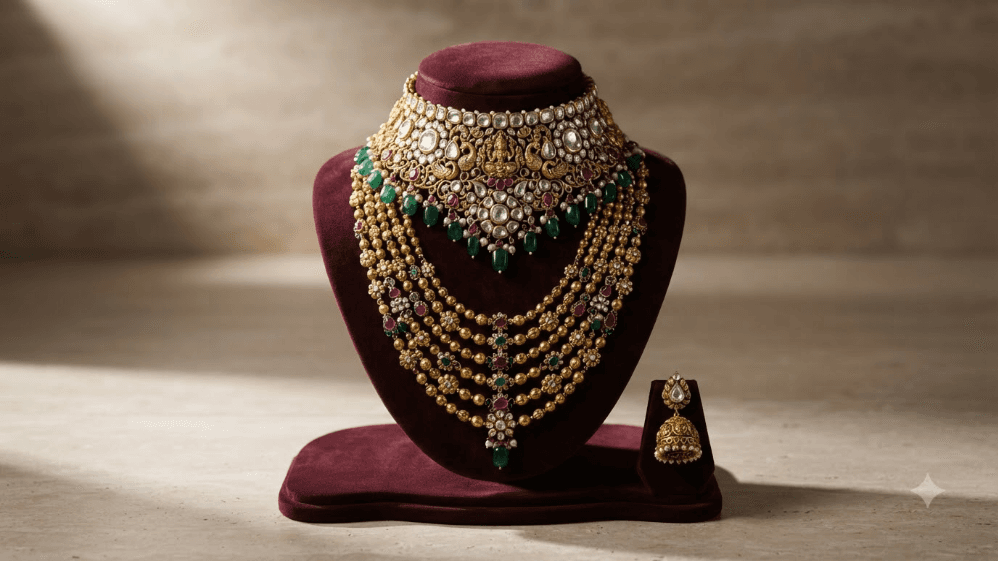
The art of embedding stones into gold using lac and heat. A centuries-old technique demanding mastery of temperature and timing.
Kundan
Stones set into molten gold using pure gold foil. No claws, no prongs, no adhesive — only gold holding the stone in place.
Polki
Uncut natural diamond, set without faceting, so the stone keeps its own character. The setting is hand-beaten gold foil, closed from behind.
Diamond Polki
A bridge between traditional polki and modern diamond work — uncut diamonds set in intricate gold frameworks with contemporary design sensibility.
Diamond
Precision-cut diamonds set in gold. Modern techniques meet traditional craftsmanship — every stone certified, every setting exact.
Temple / Repoussé
Deity and architectural motifs hammered from the reverse into thin gold sheet. The temple tradition dates to the Chola dynasty.
Meenakari
Glass enamel fused to gold at high temperature. Each colour is a separate firing. Jaipur and Bikaner are the two centres of the tradition.
Antique
A chemically aged surface that gives gold the patina and warmth of a heritage piece. The finish celebrates the beauty of time.
Filigree
Fine gold wire twisted, coiled, and soldered into open-work patterns. Requires the steadiest hand in the workshop.
House rules
Two things we will not do, at any price.
We will not subcontract any stage of production to a third party, at any volume.
We will not sell a piece without a QR-coded identity card listing every material claim.
Heritage & process